Every Thursday morning, I receive an email from the World Health Organization with an update on the status of polio eradication. It contains a wealth of information, country by country: where and how immunisation campaigns are being conducted, how many millions of children are being vaccinated, and where environmental surveillance has found evidence of circulating virus. But every week, when that email appears in my inbox, my heart seems to stop for just a moment until I read the first few lines – and learn whether a child was paralysed by wild poliovirus that week.
That, my friends, is where we are today in the work of polio eradication. The question on my mind as I open that message isn't how many thousands of cases we might see in a year, as we did not too long ago, or even how many hundreds. Instead, when that WHO email arrives every Thursday, the single, binary question it answers is: Was there a new case this week, or wasn't there?
Thirty years ago, 1,000 children were paralysed by polio every single day. Since then, we've marked our progress, year by year, week by week. We've celebrated as country after country, region after region has been declared polio-free. As we've come closer and closer to our goal, and the number of cases has dropped further and further, the children those numbers reflect have become less and less of an abstraction. When I open that Thursday email, I don't wonder what number I'll see. I wonder, was a child paralysed this week or not?
We are so close to eradication – but there is so much work left to do.
This month, I ask every Rotary club to help End Polio Now by marking World Polio Day on 24 October. Last year, thousands of Rotary clubs around the world held events to raise awareness and funds for polio eradication. This year, we want to see more World Polio Day events registered than ever. If you have an event planned, be sure to register and promote it at so that more people can take part. If you haven't planned one yet, it's not too late – visit endpolio.org to find ideas, information on this year's livestream, and resources to help your club organize a successful event.
World Polio Day is a tremendous opportunity for clubs to highlight Rotary, and our historic work to eradicate polio, in their own communities. It is also a great way to take advantage of the challenge from the Bill & Melinda Gates Foundation: For every dollar that Rotary raises for polio eradication, the Gates Foundation will give two more. Join me, and Rotarians everywhere, on 24 October for World Polio Day – and Be the Inspiration for a polio-free world.
In 1965 in Kew, Melbourne, 88-year-old Grace Tabulo passed away at her 1860’s home, Fairyland. This ended more than 20 years that Grace and her Gallipoli veteran husband Jim had made their home a tourist attraction for children in the local area and beyond.
With exhibits, stories, concerts and celebrations for events like Empire Day, Fairyland was featured in newspapers and magazines in Melbourne and abroad.
It was a unique place in a more innocent time that had a profound effect on all those who went there. What motivated this couple to dedicate their lives to their community? And what are some of the mysteries that lie behind this story?
This is a window into post-war Melbourne suburbia which celebrates a wonderful couple and their lives’ work.
James Nicolas is a Melbourne author who has written several books about local sporting clubs and institutions. He is currently working on his latest book about the history of the Blackburn Football Club. (Our own Bob Hoskins was a member of the Blackburn Team of the Century).
During his research on Fairyland, James discovered that Grace Tabulo and her husband had adopted James' mother from an orphanage. There was a falling out between James' mother and her adoptive parents when she was in her 20s. It was after that that Grace and Jim set up Fairyland.
James generously donated a copy of his book as a raffle prize.
Two men, both seriously ill, occupied the same hospital room. One man was allowed to sit up in his bed for an hour each afternoon to help drain the fluid from his lungs. His bed was next to the room's only window. The other man had to spend all his time flat on his back. The men talked for hours on end. They spoke of their wives and families, their homes, their jobs, their involvement in the military service, where they had been on vacation. Every afternoon when the man in the bed by the window could sit up, he would pass the time by describing to his roommate all the things he could see outside the window.
The man in the other bed began to live for those one hour periods where his world would be broadened and enlivened by all the activity and colour of the world outside. The window overlooked a park with a lovely lake. Ducks and swans played on the water while children sailed their model boats. People walked arm in arm amidst flowers of every colour and a fine view of the city skyline could be seen in the distance.
As the man by the window described all this in exquisite detail, the man on the other side of the room would close his eyes and imagine the picturesque scene. One warm afternoon the man by the window described a parade passing by. Although the other man couldn't hear the band - he could see it. In his mind's eye as the gentleman by the window portrayed it with descriptive words.
Days and weeks passed.
One morning, the day nurse arrived to bring water for their baths only to find the lifeless body of the man by the window, who had died peacefully in his sleep. She was saddened and called the hospital attendants to take the body away.As soon as it seemed appropriate, the other man asked if he could be moved next to the window. The nurse was happy to make the switch, and after making sure he was comfortable, she left him alone. Slowly, painfully, he propped himself up on one elbow to take his first look at the real world outside. He strained to slowly turn to look out the window beside the bed. It faced a blank wall.
The man asked the nurse what could have compelled his deceased room mate who had described such wonderful things outside this window. The nurse responded that the man was blind and could not even see the wall. She said, "Perhaps he just wanted to encourage you."
Epilogue:
There is tremendous happiness in making others happy, despite our own situations.
Shared grief is half the sorrow, but happiness when shared, is doubled.
If you want to feel rich, just count all the things you have that money can't buy.


 In 1965 in Kew, Melbourne, 88-year-old Grace Tabulo passed away at her 1860’s home, Fairyland. This ended more than 20 years that Grace and her Gallipoli veteran husband Jim had made their home a tourist attraction for children in the local area and beyond.


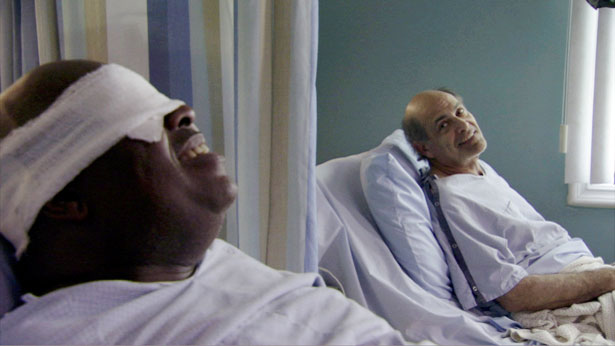 Two men, both seriously ill, occupied the same hospital room. One man was allowed to sit up in his bed for an hour each afternoon to help drain the fluid from his lungs. His bed was next to the room's only window.