Make sure you book as soon as possible for the Men's Health Matters Forum on Friday 28 April 2017 at Box Hill Golf Club - 7pm for a 7.30pm start. $65.00 per head or $600 if you book a table
There will be no club meeting on Wednesday 26 April 2017 - (see email sent by Judith on Monday 17/04/2017).
All proceeds raised will go to Australian Rotary Health and Foundation 49.
Welcome to Ann Lynch (partner of John) from RC of Eltham
Men's Health Matters Forum on 28/04/2017 - Make sure you register on trybooking if you want to attend and do your best to market the event.
RC of Croydon is running an event on 20 May 2017 called "Melinda does Doris" - it is in celebration of Doris Days 93rd Birthday. Tickets are $40.00.
Entertainment books are $70. See Russell if you want a copy or two
Market result: $3,905.00 ($2590 from stalls, $1,008.25 from donations, $306.75 from BBQ)
RC of Nunawading gave RC of Forest Hill 1.3 kg of foreign coins and notes - they sent off a batch weighing 60 kg to UNICEF recently who valued them at $1,200. So far the project has donated $5,200 to UNICEF
Sue W spoke about her recent experience in Queensland - Sue when to QLD as part of the Red Cross. They were working with the Department of Community Services to assist those affected by the floods and Cyclone Debbie. She was based in Mackay for 2 nights and then the Bowen Recovery Centre.
Our speaker was Christine Reese from the Heart Foundation
Heart disease is the biggest killer of Australians
Genetics and lifestyle contribute to risk
Heart attacks claim 24 lives on average every day
1 in 3 people don't call 000 and 1 in 3 people are waiting longer than 8 hours before they seek help.
Most people will experience warning signs. The most common warning signs are discomfort or pain in the centre of your chest, discomfort in arms, shoulders, neck, jaw or back, feel short of breath, feel nauseous, have a cold sweat, feel dizzy or light headed
One of the largest synchronised vaccination campaigns in Africa took place on 25-28 March, aiming to reach 116 million children with polio vaccines. Close to 200,000 health workers worked tirelessly over the four days to vaccinate children in 13 countries across Central and West Africa. The campaign is part of an urgent effort to stop polio on the continent following the outbreak in Nigeria in 2016.
The synchronised vaccination campaign, one of the largest of its kind ever implemented in Africa, is part of urgent measures to permanently stop polio on the continent. All children under five years of age in the 13 countries – Benin, Cameroon, Central African Republic, Chad, Côte d’Ivoire, Democratic Republic of Congo, Guinea, Liberia, Mali, Mauritania, Niger, Nigeria and Sierra Leone – were simultaneously immunised in a coordinated effort to raise childhood immunity to polio across the continent. In August 2016, four children were paralysed by the disease in security-compromised areas in Borno state, north-eastern Nigeria, widely considered to be the only place on the continent where the virus maintains its grip.
“Twenty years ago, Nelson Mandela launched the pan-African ‘Kick Polio Out of Africa’ campaign,” said Dr Matshidiso Moeti, WHO Regional Director for Africa. “At that time, every single country on the continent was endemic to polio, and every year, more than 75,000 children were paralysed for life by this terrible disease. Thanks to the dedication of governments, communities, parents and health workers, this disease is now beaten back to this final reservoir.”
Dr Moeti cautioned, however, that progress was fragile, given the epidemic-prone nature of the virus. Although confined to a comparatively small region of the continent, experts warned that the virus could easily spread to under-protected areas of neighbouring countries. That is why regional public health ministers from five Lake Chad Basin countries – Cameroon, Central African Republic, Chad, Niger and Nigeria – declared the outbreak a regional public health emergency and have committed to multiple synchronised immunisation campaigns.
UNICEF Regional Director for West and Central Africa, Ms Marie-Pierre Poirier, stated that with the strong commitment of Africa’s leaders, there was confidence that this last remaining polio reservoir could be wiped out, hereby protecting all future generations of African children from the crippling effects of this disease once and for all. “Polio eradication will be an unparalleled victory, which will not only save all future generations of children from the grip of a disease that is entirely preventable – but will show the world what Africa can do when it unites behind a common goal.”
To stop the potentially dangerous spread of the disease as soon as possible, volunteers delivered bivalent oral polio vaccine (bOPV) to every house across all cities, towns and villages of the 13 countries. This army of volunteers and health workers worked up to 12 hours per day, travelling on foot or bicycle, in often stifling humidity and temperatures in excess of 40°C. Each vaccination team carried the vaccine in special carrier bags, filled with ice packs to ensure the vaccine remains below the required 8°C.
“This extraordinary coordinated response is precisely what is needed to stop this polio outbreak,” said Michael K McGovern, Chair of Rotary’s International PolioPlus Committee . “Every aspect of civil society in these African countries is coming together, every community, every parent and every community leader, to achieve one common goal: to protect their children from life-long paralysis caused by this deadly disease.”




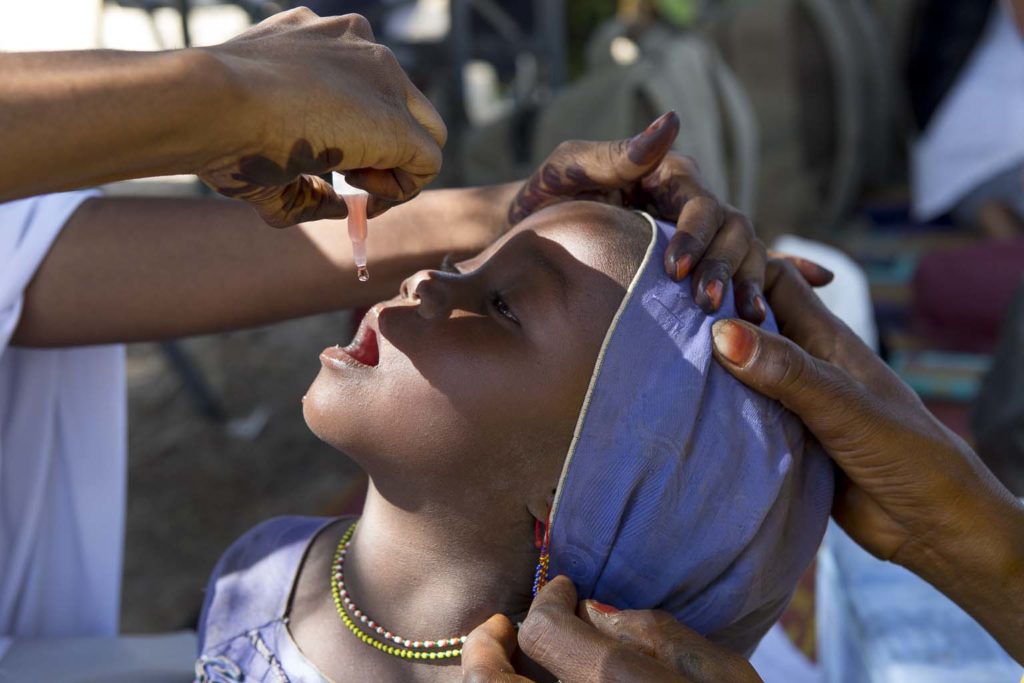 The synchronised vaccination campaign, one of the largest of its kind ever implemented in Africa, is part of urgent measures to permanently stop polio on the continent. All children under five years of age in the 13 countries – Benin, Cameroon, Central African Republic, Chad, Côte d’Ivoire, Democratic Republic of Congo, Guinea, Liberia, Mali, Mauritania, Niger, Nigeria and Sierra Leone – were simultaneously immunised in a coordinated effort to raise childhood immunity to polio across the continent. In August 2016, four children were paralysed by the disease in security-compromised areas in Borno state, north-eastern Nigeria, widely considered to be the only place on the continent where the virus maintains its grip.


